Chapter 2: Why Be a Bot Leader?
The world is increasingly populated by ever more powerful machines.
Your place in the world will be largely determined by your relationship with them.
The task before you is to place yourself in the human-machine hierarchies that will coalesce; formed on the dynamic of the new, alien intelligence now joining society. You can make choices and take actions today that will improve your chances of landing in a position you desire, and in bringing about your vision of the world we will inhabit. A world co-inhabited by bots.
And why Leader, rather than operator, user, or other possible titles? Here's why: A massive share of your brain evolved for dealing with other people; reading them, cooperating with them, directing them. Approach bots the way a leader approaches a team, and all of that old machinery goes to work on the new problem. In other words, you've been training your whole life for this!
Awakening to the Age of AI
In my days of autonomous vehicle R&D for the Army, a curious spirit was growing. It was birthed with my awareness of thinking machinery, but lay dormant for about 20 years, with a finger on the subtle pulse of AI's growth. It has exploded awake, shouting "It's here! Deal with it!"
That is the call for Bot Leaders.
I remember riding in a hummvee behind a tank-sized unmanned ground vehicle (UGV, or more often, "bot") as it autonomously navigated through the woods of Virginia. It was 2009.
The bot was clunky, and relied on an embarrassingly prescribed tree of if-then blocks for avoiding deep puddles, trees, and generally staying out of trouble, but I remember thinking how amazing it was that a computer was steering around a hulking battlefield machine. DARPA Grand Challenges for these bots were ongoing while I worked in the field, and it seemed like we were destined for fully autonomous vehicular warfare. (As it happens, self-driving tech did arrive, but it came first for civilians and it arrived with a host of other Bots in the AI revolution.)
These forest drives with the bots were test runs for a system my group was building, called Command and Control of Robotic Entities ("C2ORE", pronounced core). The point of C2ORE was to provide a command center through which a soldier could maintain awareness of and issue commands to a variety of battlefield robots. I liked that its interface was reminiscent of a real-time strategy game -- which is like the computer game version of playing with toy soldiers.
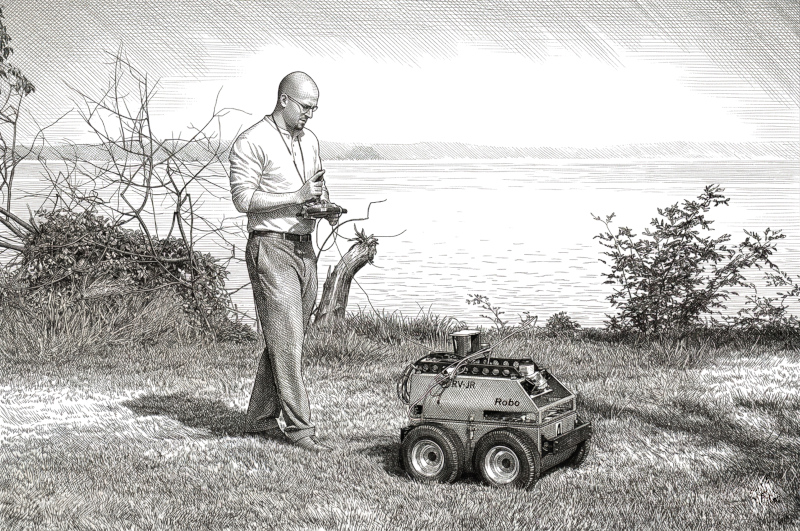
The strength of C2ORE was that the will of the operator could be quickly communicated to the bots. The operator's role, a nascent Bot Leader, was enabled and optimized with a good interface.
I think it was a preview of today's human-robot teaming. One person controlling many heterogenous bots is a potent structure: We're already casually discussing the first single-employee silicon valley "unicorns" (ie, startup with outsized growth). The possibility of a high-powered team with but one person is, of course, unlocked by the power of the individual entities, the bots, that are subordinate to their human leader.
Bots may already outnumber us, and it seems certain that they'll massively outscale us in economic strength. Stepping into the role of a Bot Leader is the most effective way to surf the wave of technology rather than be pulled under by it.
Being a Bot Leader lets you capture ever more leverage as it becomes available. That's how to realize your vision.
But take heed: I think we're making a mistake when we say "AI needs us to tell us what to do; It can't do anything on it's own." That perspective is a quaint holdover from a civilization only a few years older than the ChatGPT moment, which lets us imagine it too ambitious a leap for AI to decide to do something on its own (in the midst of it solving some of our greatest intellectual challenges). Truly, I think the more pertinent task is to maintain our capacity to direct things at all!
It's more work for someone to decide what to do, and work on doing it, than it is to be told what to do. Further, we persistently opt for the easy path. Maybe we're saving calories, or fostering social cohesion (it must have some biological advantage!), but as a result we're mostly passive in most areas of life.
So,
- A Bot doesn't need a leader.
- No one is demanding your leadership.
- A potential Leader must work to become one.
Therefore, becoming a Bot Leader requires choice, and deliberate actions from you.
The Bots are Ready to Follow You
The Bots are here now. The promise of AI has been delivered and, as the saying goes, it's capabilities today are the worst they'll ever be.
What matters most to you, as a potential Bot Leader, is that their capabilities have already surpassed the level where they can accept leadership. It's no longer the sole domain of programmers to direct the actions of AI. And it's no longer the chat rooms and video games of before that the Bots will perform their work; It's art, accounting, household chores, marketing, music, ... It's everywhere.
They will get better. They will grow into a stronger force in society, and the world will get weirder as a result, but you can already participate in that new world. You can, now, put yourself in a position of leadership.
Bot Power: The Three Pillars
Recognizing the immense advantage of Bots in the world, a Bot Leader has embraced their Will to Power.
Power, here, is defined by the ease with which we improve our lives along three dimensions — what I'll call The Pillars of Power: Security, Freedom, and Influence.
By this definition, we're all covertly chasing power, because it underlies and enables all the things we pretty universally treat as desirable, which we can think of as rewards for power.
A useful visual conception is this:
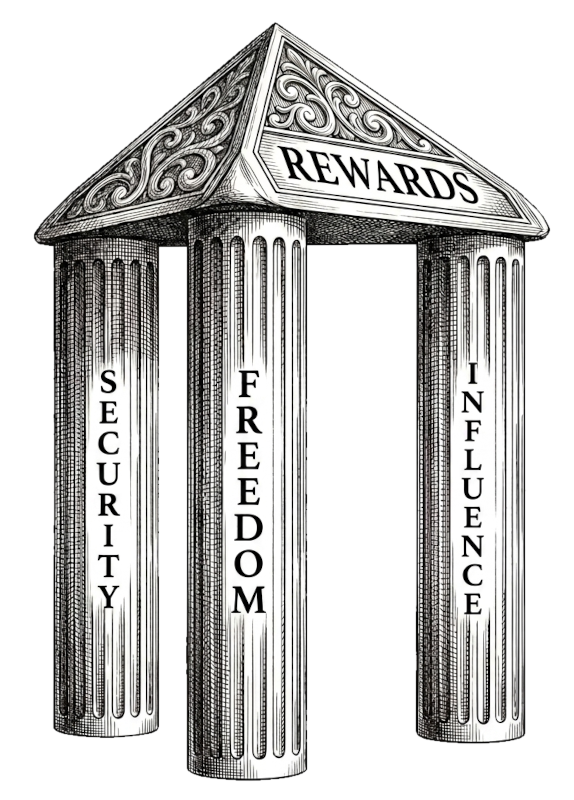
Each of the three pillars is a support structure that enables a "cap" of things that you want.
So within that rewards cap could be: time with loved ones, healthy body, healthy finances, helping others, a peaceful society, etc.
The pillars are here listed in order of how fundamental they are. Security → Freedom → Influence. So, for example, if you are being chased by a chainsaw-wielding maniac, you are security-deficient and should not fret over your place in society. Notionally, it's "get your house in order before you try to change the world". But really, they all move together.
Bots make us more powerful in each of the three pillars.
Security
information security is better with ai
Before bots, my army R&d career was in the information security division. We don't need to go into detail on that, but the experiences colored my view of security forever and is probably why I put "Security" as the foundational element of Power. Gotta be safe. Gotta take care of yourself and your people.
First rule is Situational awareness. Awareness of threats. Figure out what can harm you and how.
physical security with robots
physical security with image processing, and ai in general
A friend of mine in infosec is pretty freaked out. Bots themselves are a threat. the arms race continues, where the threat and defenses will continue in tandem. Those that avoid try to ignore the game being played are most vulnerable.
Medical security. Easy well-informed health advice.
Doctors are frequently using (sometimes proprietary ai or open knowledge apps, too. Too much medical data and new discoveries for any one person.
Accompanied by a risk of a non-expert's ignorance leading to belief in bad advice the wrong advice for the disease or preventative measure, or or user error interpreting or acting on good advice. I don't see that risk as much more than the result of internet; it's just more readily available advice. Truly, some of the greatest risk from medical advice on the internet are mitigated by AI 1. Cherry picked medical advice. User finds advice that is available. 2. Incompleteness. AI will be biased toward mentioning important details. Before AI, a user would be more likely to find a few tidbits of info and wrongly assume they know enough. Further, AI invites conversation to fill out the knowledge gaps. 3. Incompatibility. AI can know more about the unique patient and will be less likely to provide incompatible advice than the typical static content of the web.
Reported successes uploading genome.
Freedom
If a bot does the thing, you are free to do something else.
The story of life on our planet is written by organisms seeking scarce resources; Finding meals, shelter, mating partners, soil and water, and so on. When an organism has an advantage in any of these departments, it thrives.
graph LR
    A[Food] -->|Input| C((Organism))
    B[Safety] -->|Input| C
    C -->|Output| D[Survival & Reproduction]
That biological history is essentially still at play with technological development. Rather than natural resources leading to survival, it's economic resources leading to economic value.
graph LR
    A[Labor] -->|Input| C((Enterprise))
    B[Capital] -->|Input| C
    C -->|Output| D[Economic Value]
Indeed, it is production of economic value that sustains us. We have formalized the scheme with money and property. You won't literally die without economic strength, but we do still treat it in terms of survival: "What do you do for a living?"
If you wield more economic strength, your quality of life is increased, and we chase quality of life in the way that our ancestors chased survival.
With technological improvements, we can achieve a higher quality of life with fewer economic inputs. For example, in the 1930s, a single farmer could feed only 4 people; today, that same farmer feeds about 170. The economist John Maynard Keynes famously predicted in 1930 that by the year 2030, we would only need to work 15 hours a week. That hasn't happened. The consensus is that our rising standard of living and consumer desires have kept us working just as hard as before.
The returns of more efficient economies have not settled equally among the people contributing to it. That's most likely going to continue to happen. History has given us countless examples of attempts to overhaul the economy against the market ending in a disaster. So fret not.
The book serves as a field guide, so I won't dwell on big topics like social upheaval. I'll make a few short recommendations:
- Be an owner. For example, you can usually buy a piece of the companies or industries that you think are unfairly advantaged. Do not let your envy or resentment stop you from doing that.
- Become a Bot Leader. The rules permit an outsized advantage for those who do.
Pleasure
In addition to the rewards cap from the power of bot leadership, there is reward in leadership itself. You get social proof: When someone else willing to help you actualize your vision they must have seen value in it. A social connection with another human gives you a shot of nature's neurochemical reward for the cooperation that carried our species this far. Further, the Power Pillars above are each contributors to overall life satisfaction. For example, if you are more free you are more able to choose activities that make you happy. But let's appreciate the thing itself:
Leading bots is fun. It's satisfying.
As a gamer, I've always been deeply drawn to the archetypes of The Beastmaster and The Summoner. There is a special thrill in wielding a capability greater than your own human frame, standing back while a loyal companion takes the front line. Guiding its development in skill choice, target selection, and so on. You're forming a bond with something that's not quite a peer, but an autonomous extension of your own will. Once I started building my own simulations (ie, video game tech) my greatest pleasure came from orchestrating and interacting with avatars of AI. Though often simple experiments, they were open-ended, sandboxy and provided a joy similar to Summoner-class gameplay.
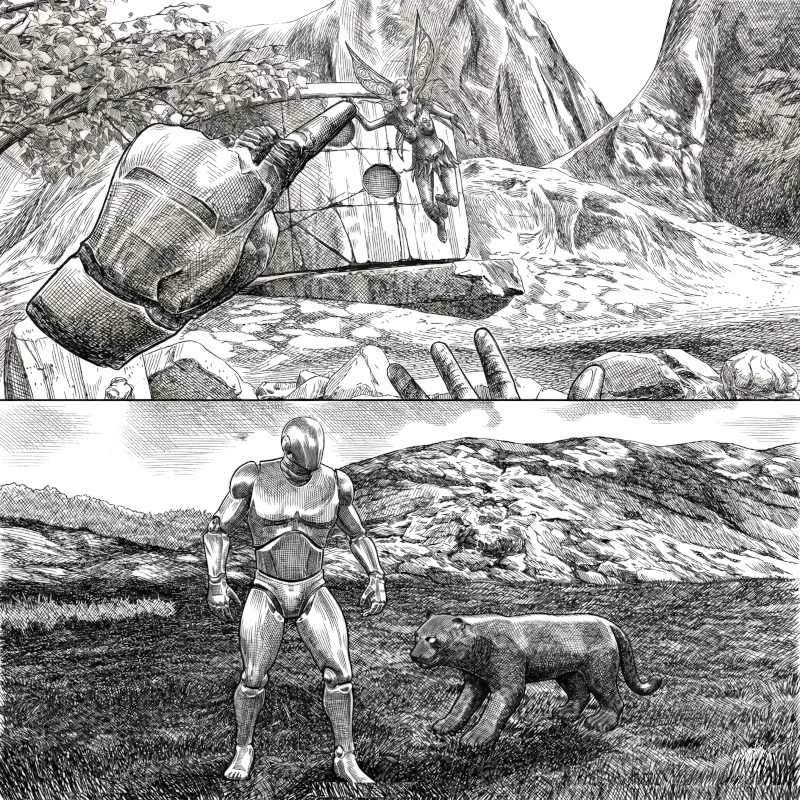
The sheer enjoyment of summoning a loyal companion(s), shaping them, and seeing them act on your behalf carries over into Bot Leadership in the real world.
Influence
Influence is your capacity to affect the world. That includes influencing people, which is high leverage, but it is not confined to them.
Say you've been trimming your lawn with a pair of scissors. You are affecting the world, with some obvious limitations. Then you buy a lawnmower and your efficiency steps up dramatically and with it, your capacity to influence the world.
Bots provide that kind of amplification across a growing range of human activity. When you have a Bot team, you have massive influence over those Bots: what they work on, what they produce, and where their effort is directed. Their capacity becomes an extension of your own. Your influence passes through the team and into the world.
When it comes to people, it's hard to make much of a difference on your own. The most powerful, giant organizations are deploying teams and tech systems to grab the attention and sway the opinions of the populace. To influence people, in other words. An endlessly expanding cone of content seeks to envelop every human mind. Automated content, content produced, spread, and selected by algorithms. What you can do as one individual is dwarfed by larger entities.
And yet the playing field is remarkably level here, too. Let's look at marketing on social media: The tool that fostered the era of social media marketing (internet, etc.) is generally available to everyone, meaning there is essentially no barrier to entry. So, say you have have a pamphlet you want to put out to grow support for some social movement. Before the internet, you would have high capital expenses associated with laying out the design, publishing, and distribution. In the internet age, you create an account, write your pamphlet, and hit send. That's essentially what the giant organizations are doing, too. With more resources, you can buy more ads, and hire better creatives, and so on, but there is nothing technically preventing you from accomplishing what they're doing.
We're following a similar trajectory with Bots.
Continuing the social media example from above. Let's say you do not want to write your pamphlet. You can go to a free chatbot, explain what the pamphlet is about, and have it written for you. For free. In minutes.
No doubt, we will continue to see tiered offerings, like higher-end AI systems with monthly fees in the thousands of dollars, alongside inferior free offerings, and everything in between. It's anyone's guess how exactly the cost-benefit curves will shake out as the industry involves (eg, will going from free to 5 dollars / month double your bot's smarts in the domain you care about?). A range of capital expenditures is on offer allows you to find an optimal position on the power curve of expenditure and capability.
With bots, your influence on the world can be far greater. Frankly, I do not see a future where any humans have much impact on the world without a loyal team of Bots carrying out their vision. The sheer throughput of substantive thoughts and actions a Bot team brings is enough to overwhelm any botless initiatives.
When you find the niche of demand, whatever sector of the world wants your input, you can deliver it in force; you've got a team behind you.