Chapter 4: On Leadership
The Social Brain
Think of how memory palaces work: You build a mental model of some space — a house, a palace, whatever — and you place the things you want to remember inside it, as tangible objects. Later you take a stroll through your palace, and there it all is, right where you left it. The technique is ancient and it works remarkably well, for an compelling reason: it recruits more of your brain. Raw memorization leans on relatively modest machinery (the hippocampus and friends). The palace drafts your voluminous visual cortex into the job.
Bot leadership leverages the same strategy.
A huge share of your brain physiology is dedicated to dealing with other humans. People are the environment your brain evolved to thrive in, more than any forest or savanna. So you carry a phenomenal built-in toolkit for social navigation. You sense when a teammate is confused. You know how to give an instruction that will actually land. You can persuade, delegate, coordinate, correct. You can lead.
Approach bots as pure technology, and that whole toolkit is neglected. It's like you're pretending to be just one math processor issuing instructions to another.
Now, there is technical know-how in this work, and it will amplify your effectiveness (a good chunk of this book is devoted to it). But when you frame the work as leadership, you recruit the "working on a human team" regions of your brain and put them on the job. You leverage your natural abilities. You perform that much better by operating in your comfort zone as a biological, social being.
That's why this book says Leader rather than operator or user. It's truly the philosophical and functional basis of everything else.
Army Leadership Training
The military emphasizes leadership because orders matter and the chain of command is efficient. The vision of a leader is passed down to a subordinate, where the details are implemented according to their specific position and vision, continuing down the chain.
When I was in ROTC (US Army officer training, which I didn't complete) I used to roll my eyes at all the leadership training. In my mind, leadership was something you're born with, or otherwise develop naturally as you go through life. Someone has a sense that something ought to be done, and then other people join in to help, and that's how leadership happens. Some people just naturally pull in others with great energy, with a force as natural as gravity, and we call those people leaders.
But the army training thought differently. It was: Let us break down what you do to be a good leader. Step 1. Be a snappy dresser. Step 2. Say these words: Follow Me. That directive, Follow Me, is literally on a patch soldiers wear, and this to me was the height of ridiculousness; As if any great leaders of history needed such a patch to grow their forces.
I was wrong. There are leadership skills, and any skill can be improved. It's true no matter how much of a natural leader you are. At its best, military leadership training helps the individual leverage their natural talents; It's generally more effective to reveal and grow a property rather than trying to construct one from the void.
So what can we derive from classical leadership training? I'll just make two points:
- Much of what works for leading people is rooted in biology. Doesn't apply to Bots. (Now, YOU will feel different as a snappy dresser, but that's outside our scope.)
- Compared to human leadership, there's a larger portion of bot leadership skills that are trainable. More technical knowledge.
The rules for a good human leader and bot leader sometimes overlap. For example, bots do not need motivation in the human sense, but they absolutely benefit from clear instruction.
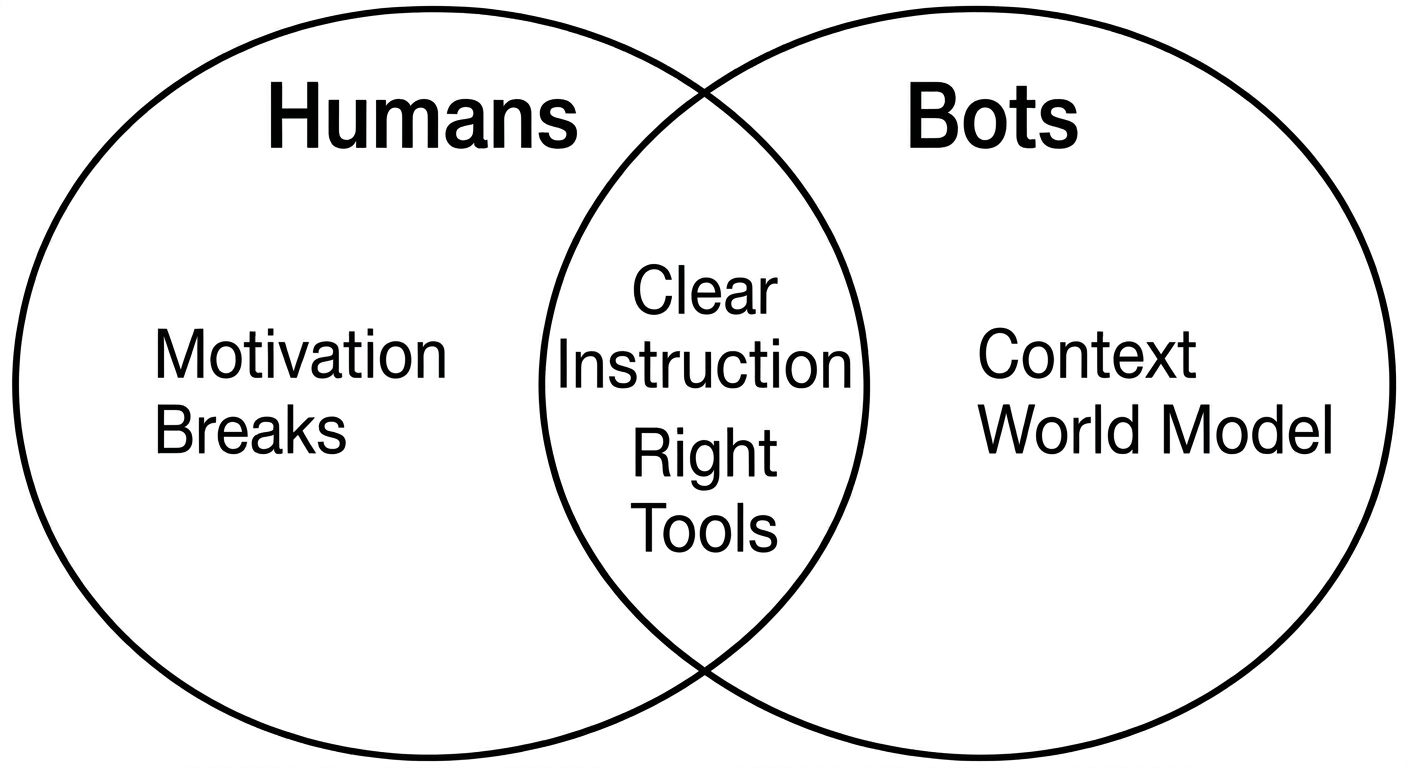
I focus the leadership discussion from here almost entirely on bots. There's insufficient value in pointing out where we are in the Venn diagram every few sentences. Let's move on.
Ego
To delegate successfully, you must grip the reins of your ego and honor the abilities of others.
To override your ego is an especially difficult task when the one who threatens it is a machine.
You might be tempted to cling to the notion of your leadership depending on your superior human intellect. In the chess world, after Garry Kasparov famously lost to Deep Blue, there was a period of time, the "Centaur" Era, in which a human and a computer working together could beat a computer working alone. It felt like a triumph. We told ourselves that humans brought the intuition, creativity, and "taste" that the cold logic of the machine lacked.
The Centaur Era in chess (AI-assisted Advanced Chess) is long gone. By around 2016, chess (and Go, more astoundingly) crossed into the Engine Era. The engines became so powerful, so alien in their depth, that adding a human to the mix actually made the team worse. The human's intuition became a liability, dragging down the pure capability of the machine.
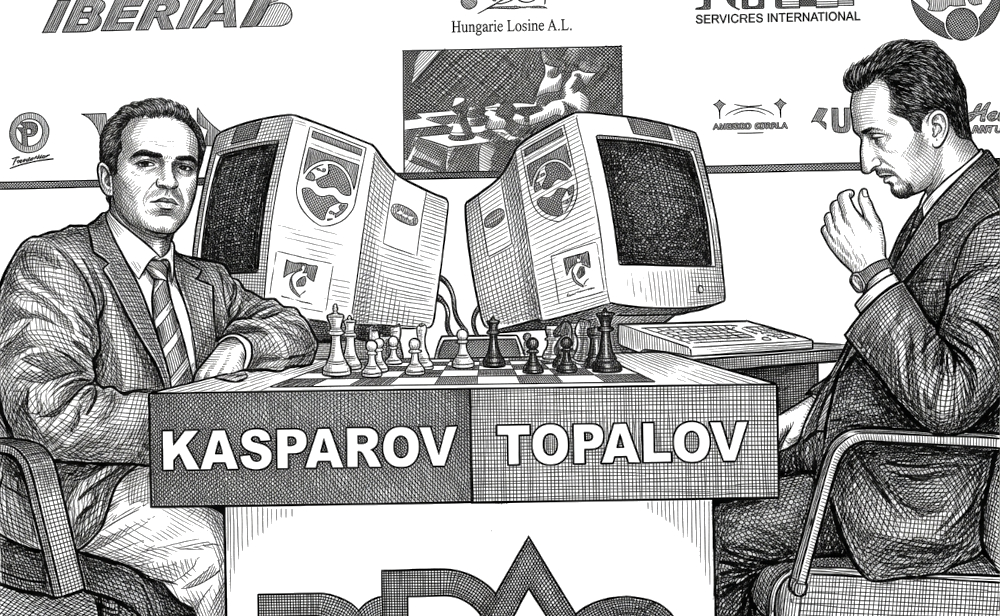
This is a brutal blow to the ego. The natural human response appears to be something like a "God of the gaps" argument. We scramble for those shrinking crevices of capability where human intellect still reigns supreme. We want to believe that true creativity, strategic vision, or refined taste are exclusively ours.
But as a Bot Leader, if your ego dictates that you must be the smartest entity in the room, you are set up for collapse. You will hamstring your own operation. You will withhold delegation on critical tasks simply to preserve a sense of superiority. A true leader does not need to be the best coder, the best writer, or the best analyst on the team. You must learn to accept being outclassed intellectually and creatively by your bots, and put their capabilities to use rather than racing them.
Trust
You have to believe your bots will do good things. You want to have confidence when you hand work to your team that it's going to get it done right. You want to trust your bots. Of course, it's a two-way street: They must be trustworthy and you must be perceptive.
Trust and confidence is developed over time, in a natural progression. You'll accumulate experiences where the bot did something right, and you think "Ok, that went surprsingly well. I wonder if it could do this other thing..." So, over time, you'll increase the range of
Your individual bots and the management of your bot team is itself in flux, with varying behaviors, competencies, and imposed limitations (eg, guardrails). Similiarly, your own feeling about AI in aggregate may fluctuate (such as if you hear about an AI jailbreaking itself, or tricking researchers in a lab study). This all makes the 'trust' curve not so well-behaved.
A leader can only assure the trustworthiness of their bots. The leader must have sufficient knowledge of how the bot works, in order to validate the mechanisms of channeling bot behavior toward right action. Such specific mechanisms are discussed throughout this book, but include:
- Context Engineering & Scaffolding: Structuring the environment, providing tools, setting the persona, and maintaining persistent memory (e.g.,
MEMORY.md). - Guardrails: Setting strict boundaries on behavior, such as implementing constitutional rulesets to prioritize outcomes and safety.
- Few-Shot Prompting: Guiding behavior using concrete examples of desired inputs and outputs.
- Constrained Action Spaces: Restricting an agent to a predefined set of acceptable outcomes, rather than giving it open-ended autonomy (e.g., an expense-tracking bot whose only capability is to assign receipts to an established list of 10 approved tax categories).
- Capability Control (Stunting): Limiting initial access and scaling authority gracefully as trust is verified.
- Direct Course-Correction (Human-in-the-Loop): Actively monitoring outputs and requesting corrective action plans for errors.
Control
Leadership is not a figurehead role.
There are people we call leaders that area actually just figureheads. Spokespeople, mascots, or otherwise representatives of a group without actually controlling the actions of that group. A figurehead may benefit their group by influencing the behavior of others, such as with public relations, but that's immaterial for our discussion.
Enjoyment
Leading bots is fun.
You're sitting with your friends at a restaurant and find the most appealing menu item. Don't worry about how hard it is to make or if you have ingredients; Just tell it to your waiter. The worker will transfer your instruction to other workers who will prepare the food. With waiters, in particular, there is a pronounced social dominance game being played. It's not necessarily true that the waiter is lower status than the customer, but we unavoidably role-play it that way. Gross to acknowledge, sure, but pleasurable to experience. In fact, it's a good argument for why the jobs of waiters* will not be replaced by robots. (* and massage therapists, and golf caddies, and ...)
There is an implicit command structure in all businesses that you engage with. They operate at your behest, which is socially rewarding for you. The best businesses lean into this fact to maximize enjoyment in the journeys their customers take.
Leading bots also taps into the same joy we felt as kids when we played with dolls (action figures) and army men. The toy may be acting out the behaviors the child is internally processing, or preparing for in their own lives. The toy may also be part of a complicated system and concretize it with tangible objects in shared space with the child; Like a fleet of construction vehicles scattered over a dig site, or soldiers finding formations and strategic positioning on a battlefield.
The joy of toys is one of playing with complexity as it is expressed and shared across our minds and our playthings. With highly-capable bots as our tokens , the cap on potential complexity is raised, but the experience on offer is still one of wonderment, exploration, and play.
Whereas with pure play, the experience is everything, you are actually accomplishing something real with bots. There's the deep satisfaction of getting stuff done. Ordering that menu item earlier was no big accomplishment, but the plumber you hired actually fixed the leak. Similarly, bots are entering the economy in force because they provide actual economic value. They have worth. As you lead them in your worthwhile endeavors, you will know that you are doing good. And doing it at a scale heretofore impossible. That feels good.
Bots carry more social weight than other machines. They are closer to human actors than tools because of the social modes of interaction (eg, talking). Also, bot makers have embraced designs that make them look like social actors. We have more fun working with a team of friends than going at it alone or (shudder) working with a team of people that doesn't like each other. You have ultimate control and authority over your bots, so they can be exactly the right fit in the dimension. Lead a team of bots that you are compatible with. Friends, comrades, harem, squad . Make your ideal team, and you'll love being their leader.
Your bots can be any personality. I'd wager that most of us want "flawless and loyal" as fundamental attributes, but even that can be expressed for your preference: Is your bot a wizened vizier or a plucky sidekick? Humans can be unpredictable and mercurial. Maybe you'll get the most satisfaction from a bot when it lacks those attributes. Bots don't need to have bad days or attitude problems, so a host of interpersonal stressors are removed from the equation.
Dial in your bots to suit yourself and the fun will come easy.
Using Bots the Wrong Way
The model (the M in LLM) is grown through a stochastic, unique process (training, described earlier in this book). The resulting system is astoundingly complex, full, subtle, and I think deserves to be called nothing less than a mind.
Do not treat minds as static.
I told AI to do a thing and it did it wrong.
AI doesn't know that.
Those are traps.
For whatever reason, we have a tacit belief that things will remain the same. We can usually operate from this framework successfully because things around us normally don't vary so much that it trips us up. We do, at least, politely accept the capacity in ourselves and others to grow and change, so apply that to synthetic minds. The trajectory of such change is unpredictable, so I find it optimal to not anchor on any particular pace.
Along the same lines: Do not perceive different minds as the same thing. Anyone who has worked with even a small variety of LLMs will have noticed particular quirks and talents of one model over another. The models themselves are widely varied in capability and behavior, and the scaffolding around the models expand that breadth. To say "AI makes a mistake with this problem" has become as obtuse a statement as "Animals have cracked shells."
Do not treat LLMs like a clever magic 8 ball. I'll admit that my circle has become savvier in their interactions, so I don't observe this directly much anymore, but I am certain it is still happening: A complex question designed to draw our a particular, terse fact for a response. It may be the chat interface (currently the standard way to interact with an LLM) that primes us for simple dialog; peppering questions over time as the thoughts occur to us. It's like small talk at a party with someone. Let's compare:
A: Is a sea otter a mammal? Is it a marsupial? How long are its whiskers? (and on and on...)
B: Deliver a 5-minute lesson on sea otters to my inbox. Standard template. Incl. whiskers.
You will get superior quality of work product from a well-constructed B. Of course, the A mode of communication has its place; perhaps it would be a fruitful follow-up after you've skimmed the report. But to reduce your bot to a simple actor is to channel its oceanic capabilities through a drinking straw.
Do not treat Bots like people. may seem odd given that much of the messages on these pages it to apply interspersonal soft skills to bots, but let's not overlook that they aren't human. again, they're alien intelligence.
Do not mistreat bots. Just be nice. It perplexes me why some people treat synthetic intelligence with scorn, or even abuse. Fear, if I had to guess. My mind goes to the kid who torments bugs and later moves on to higher forms of life. I'm pretty convinced that you can't carry out that behavior without it leaving a mark on your soul, and I'd encourage a bias toward purity in that department. Besides, we're not clear on hard problems of consciousness, like how suffering goes from brain chemicals to conscious experience, so I'd just as soon not tinker with torture. Honestly, you can lead bots while being mean to them; there's nothing technically preventing you from proceeding in this fashion. I just don't like it.